








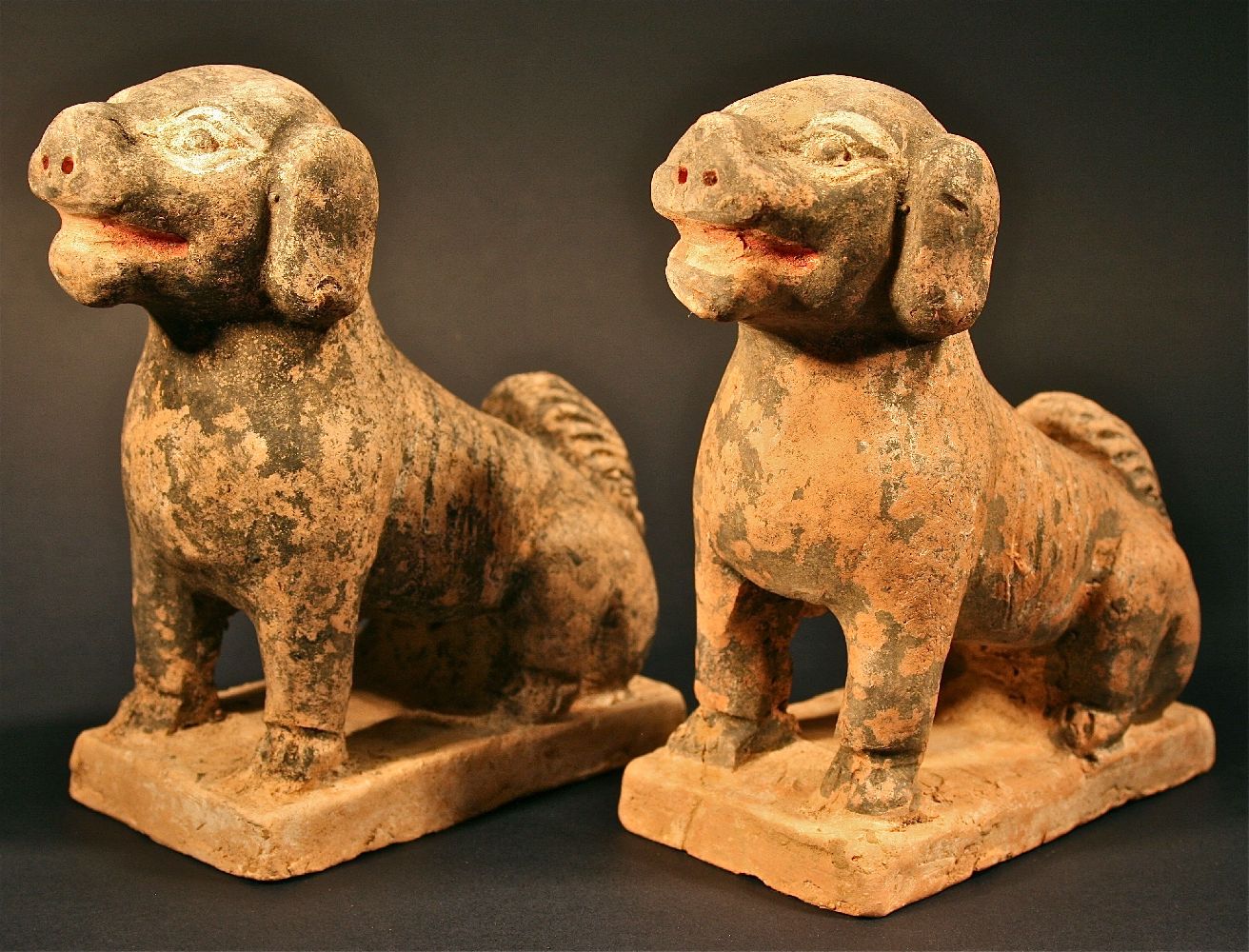
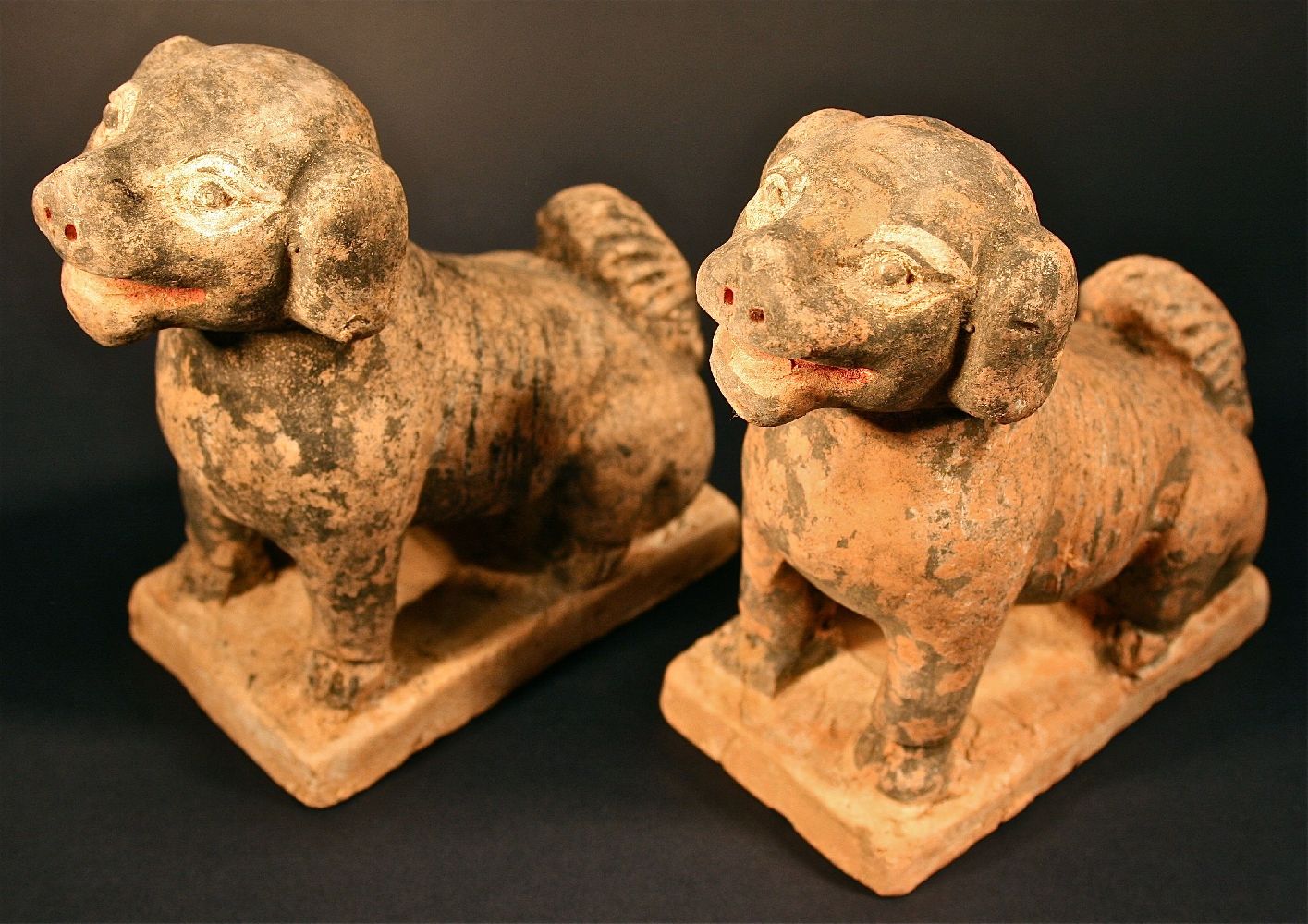
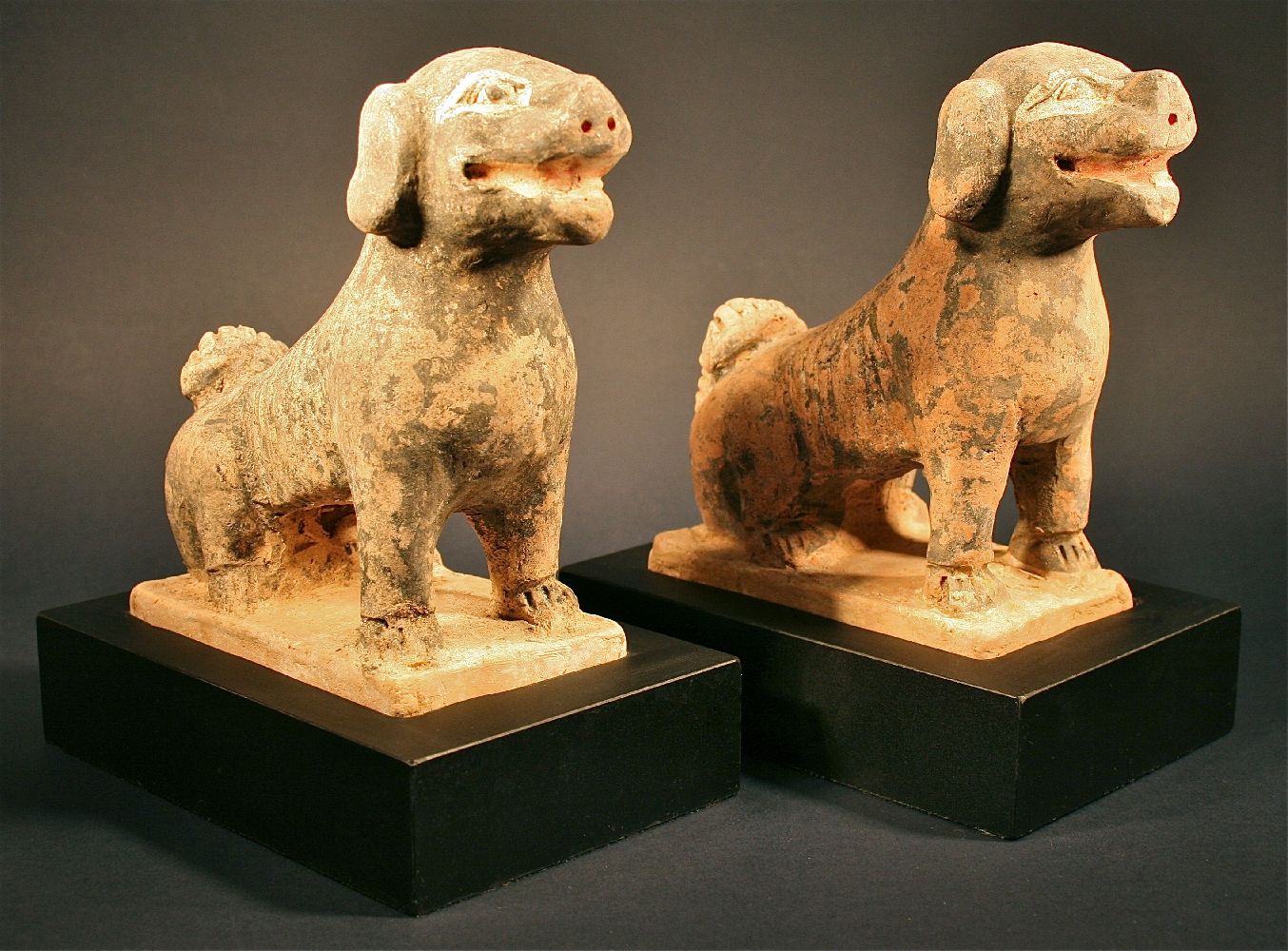
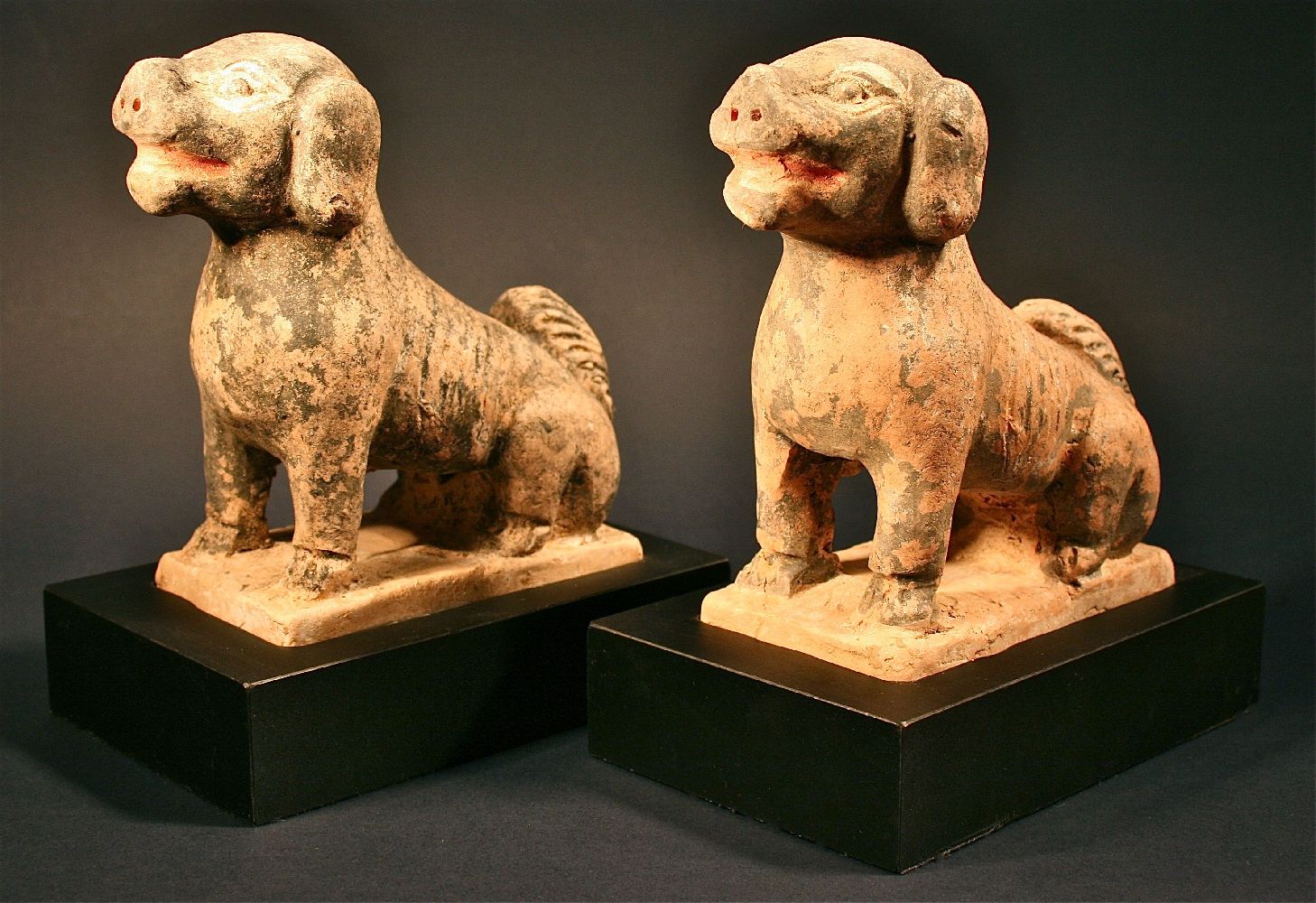
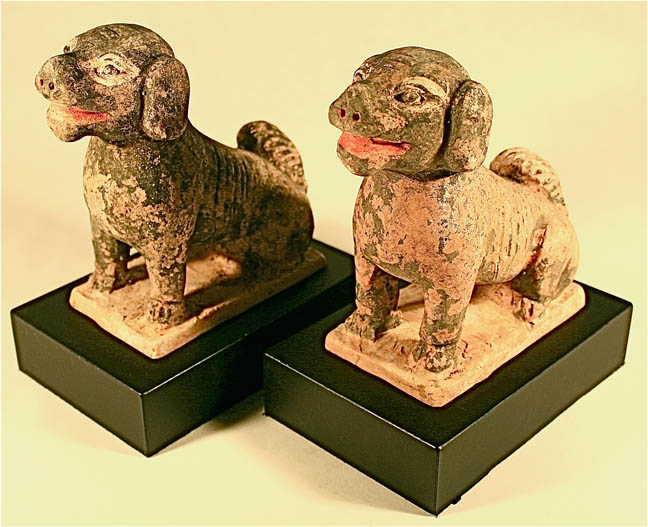
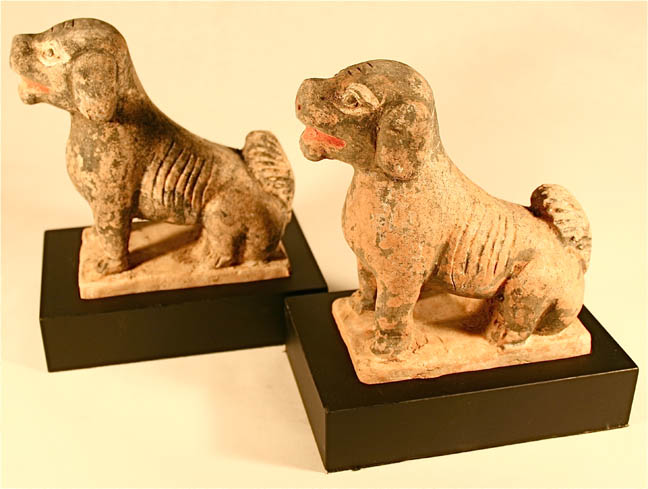
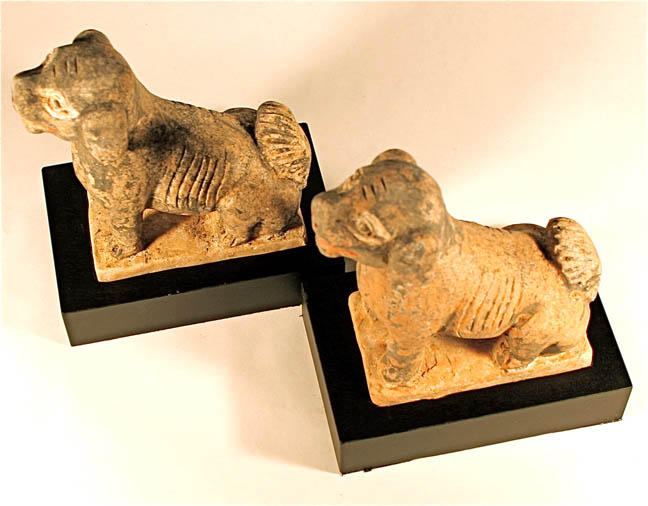
Title: Chinese Artifact Clay Terracotta Polychrome Sitting Dogs Ming Dynasty
Catalog Number: 370
Category: Pottery / Ancient
Artist:
Country & Origin:
Historical Period: Unassigned
Approximate Date:
Signature: Unsigned
Condition: Museum Quality
Size:
Height: 4 1/2 inches
Width: 5 inches
Depth: 2 inches
Weight:
Description & Provenance: Museum-Quality Clay Dogs, Ming Dynasty (1368–1644). These bold and lively painted standing dogs are a striking example of Ming Dynasty terra-cotta craftsmanship. Slightly oversized, they feature some of the most expressive and finely detailed facial features we have ever encountered in this form. Their scale, as depicted in the images, scarcely conveys their true presence. If you have a moment, we invite you to watch the fascinating video. While these pieces have not undergone TL testing, a Certificate of Authenticity can be obtained upon request for a fee through a reputable lab in Oxford, England. Additionally, we have access to one of the top importers of Chinese artifacts, ensuring their provenance and authenticity. Chinese guardian lion statues—often referred to as "Fu Dogs," "Foo Dogs," "Fu Lions," "Fo Lions," or "Lion Dogs"—are deeply rooted in Chinese art and culture. Although lions are not native to China, except possibly in the far western regions, they were widely known and imbued with symbolic significance. In Chinese artistic traditions, lions were often depicted with dog-like features, blending mythical and realistic elements. As scholar C.A.S. Williams observed, “The ‘lion’ depicted in Chinese paintings and sculptures bears little resemblance to the real animal. However, it holds a significant place in Chinese folklore.” The Western practice of referring to these figures as "dogs" is intriguing and widely recognized, though its origins remain somewhat obscure. Our Commitment to Quality All of the art featured here is carefully selected for its exceptional quality and craftsmanship before being presented. At Busacca Gallery, we are passionate about enriching our customers’ lives by discovering, curating, and showcasing the finest art from around the globe. As tastemakers, art advisors, consultants, and publishers of spectacular art stories, our mission is to serve as trusted intermediaries between buyers and sellers. We are dedicated to vetting high-end art for discerning patrons, cataloging the world’s most extraordinary pieces, and making them accessible to collectors everywhere.
Origin, Encyclopedia & Researched Articles:
Encyclopedia Name: http://en.wikipedia.org/wiki/Dog_in_Chinese_mythology
Dogs are an important motif in Chinese mythology. There are many myths about dogs. Chinese mythology refers to those myths found in the historical geographic area of China. These include myths in Chinese and other languages, as transmitted by Han Chinese as well as other ethnic groups.
Note that despite any fantastic myths from China about dogs, real dogs have been familiar throughout China since prehistorical times (unlike certain exotic animals, such as lions or other creatures, whose real attributes may often only have been known indirectly). Dogs also feature in various historical and legendary accounts or stories, found in the extensive literary records of China, although in some cases the lines between myth and ancient history are uncertain. However, in many myths, legends, or other accounts of dogs in Chinese literature, the dog or dogs are presented in ways that in have no appearance of the fanciful or fantastic (as opposed to the way other creatures may typically be handled in mythology, such as in the case of turtles, snakes, dragons, or often even horses).
Numerous statuary of Chinese guardian lions exist, which are often called "Fu Dogs" "Foo Dogs", "Fu Lions", "Fo Lions", and "Lion Dogs". Modern lions are not native in the area of China, except perhaps the extreme west; however, their existence was well known, and associated symbolism and ideas about lions were familiar; however, in China, artistic representations of lions tended to be dog-like. Indeed, "[t]he 'lion' which we see depicted in Chinese paintings and in sculpture bears little resemblance to the real animal, which, however, plays a big part in Chinese folklore. The reasons for referencing "guardian lions" as "dogs" in Western cultures may be obscure, however the phenomenon is well known.
The motifs of dogs in Chinese mythology include a particular dog which accompanies a hero, the dog as one of the twelve totem creatures for which years are named, the first provision of grain which allowed current agriculture explained as having been by means of a dog, and claims of having a magical dog as an original ancestor in the case of certain ethnic groups.
For thousands of years, a twelve-year cycle named after various real or mythological animals has been used in Southeast Asia. This twelve-year cycle which may be referred to as the "Chinese zodiac" associates each year in turn with a certain creature, in a fixed order of twelve animals, after which it returns to the first in the order, the Rat. The eleventh in the cycle is the Dog. One account is that the order of the beings-of-the-year is due to their order in a racing contest involving swimming across a river, in the so-called Great Race. The reason for the dog finishing the race second from last despite generally being a talented swimmer is explained as being due to its playful nature: the dog played and frolicked along the way, thus delaying completing the course and reaching the finishing line. As of 2012, the next Year of the Dog in the traditional Chinese sexagenary calendar is February 19, 2018 to February 4, 2019 (Year of the Yang Earth Dog). The personalities of people born in dog years are popularly supposed to share certain attributes associated with dogs, such as loyalty or exuberance; however, this would be modified according to other considerations of Chinese astrology, such as the influences of the month, day and hour of birth, according to the traditional system of Earthly Branches, in which the zodiacal animals are also associated with the months and times of the day (and night), in twelve two-hour increments. The Hour of the Dog is 7 to 9 p.m., and the dog is associated with the ninth lunar month.
Encyclopedia Name:
The earliest known ceramic objects are Gravettian figurines such as those discovered at Dolni Ves
Verbal History:
Terracotta, Terra cotta or Terra-cotta (Italian: "baked earth", from the Latin terra cotta), a type of earthenware, is a clay-based unglazed or glazed ceramic, where the fired body is porous. Its uses include vessels (notably flower pots), water and waste water pipes, bricks, and surface embellishment in Building construction, along with sculpture such as the Terracotta Army and Greek terracotta figurines. The term is also used to refer to items made out of this material and to its natural, brownish orange color, which varies considerably. In archaeology and art history, "terracotta" is often used of objects not made on a potter's wheel, such as figurines, where objects made on the wheel from the same material, possibly even by the same person, are called pottery; the choice of term depending on the type of object rather than the material
As compared to bronze sculpture, terracotta uses a far simpler process for creating the finished work with much lower material costs. Reusable mold-making techniques may be used for series production. Compared to marble sculpture and other stonework the finished product is far lighter and may be further glazed to produce objects with color or durable simulations of metal patina. Robust durable works for outdoor use require greater thickness and so will be heavier, with more care needed in the drying of the unfinished piece to prevent cracking as the material shrinks. Structural considerations are similar to those required for stone sculpture.
Information:
Personal Story:
Chinese guardian lion statues, often referred to as "Fu Dogs," "Foo Dogs," "Fu Lions," or "Lion Dogs," have a rich history rooted in Chinese tradition and symbolism. These statues were believed to offer protection, ward off evil spirits, and bring prosperity to those who placed them at entrances to homes, temples, and imperial palaces. While lions were not native to China, they became known through trade and cultural exchanges with regions like India and Central Asia, where lions held a prominent place in art and mythology. Over time, Chinese artisans reimagined lions through a distinctly local lens, blending their features with dog-like characteristics and infusing them with mythical qualities. These depictions emphasize strength, vigilance, and benevolence, often portrayed as pairs—male lions with a globe representing dominion and females with a cub symbolizing nurturing. Their enduring popularity speaks to their timeless role as both guardians and symbols of auspiciousness in Chinese culture. The Ming Dynasty (1368–1644) was a period of remarkable cultural, political, and economic achievements in Chinese history. Following the decline of the Mongol-led Yuan Dynasty, the Ming Dynasty was established by Zhu Yuanzhang, also known as Emperor Hongwu, who rose from humble beginnings to become one of China's most influential rulers. The Ming era is renowned for its centralization of government, agricultural reforms, and restoration of traditional Chinese culture, which flourished after decades of foreign rule. Under the Ming, China experienced a resurgence of Confucian ideals, a strengthening of the civil service system, and advancements in literature, painting, and porcelain craftsmanship. The dynasty's maritime expeditions, led by Admiral Zheng He, expanded China's influence across Southeast Asia, the Indian Ocean, and East Africa. Architecturally, the Ming period saw the construction of the Forbidden City in Beijing and the reinforcement of the Great Wall. However, the later years of the Ming Dynasty were marked by corruption, internal strife, and fiscal challenges, compounded by natural disasters and external threats. The dynasty ultimately fell to the Manchu-led Qing Dynasty in 1644, but its legacy remains a cornerstone of China's cultural and historical identity.


Comments are subject to review
Be the first to comment!