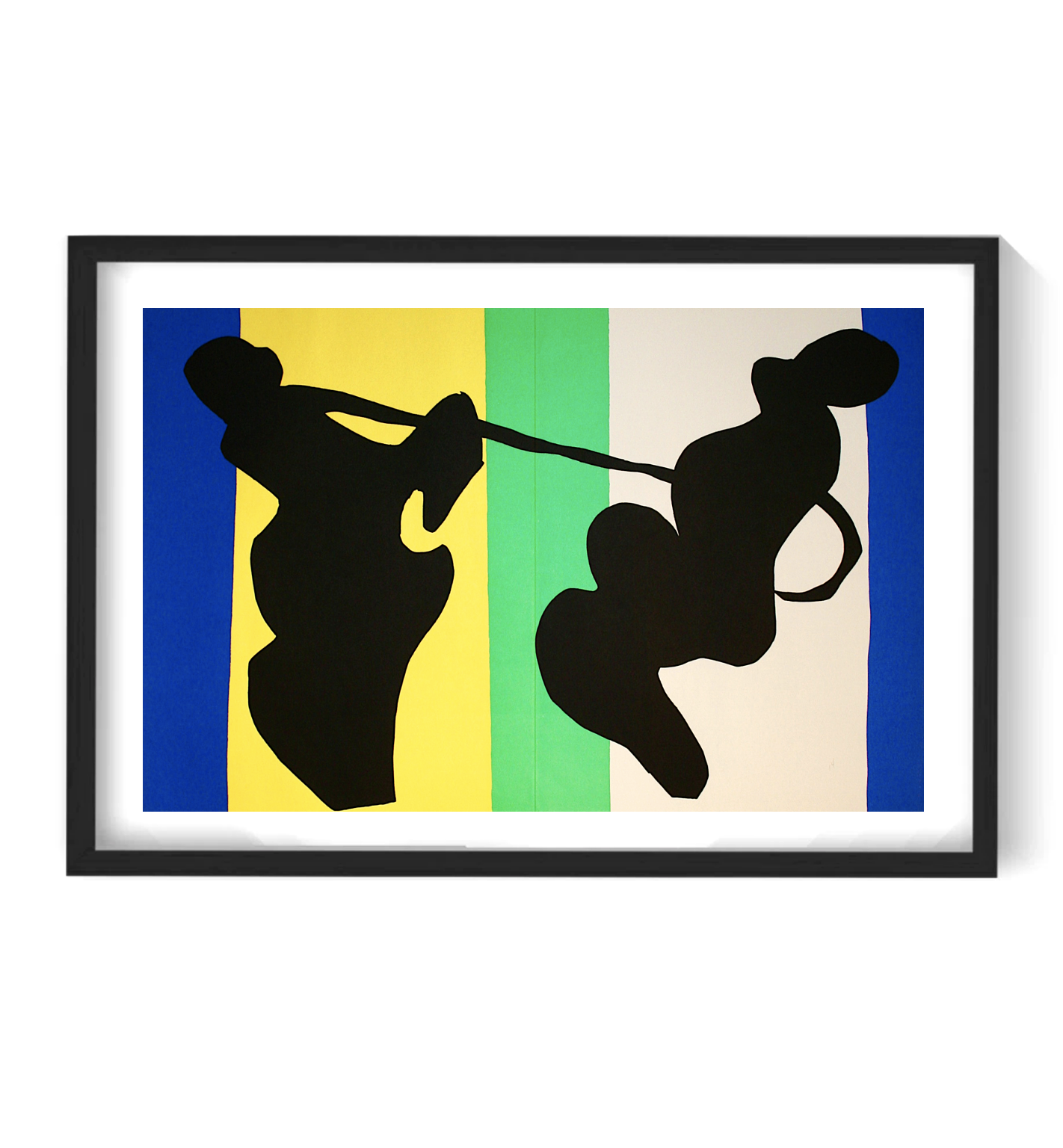


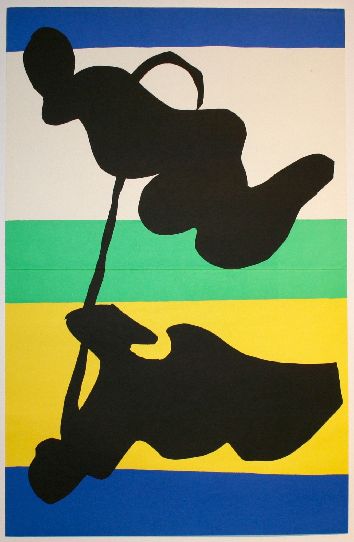
Title: Lagoon 1944 (Jazz) Henri Matisse Original Pochoir Print
Shipping: $29.00
Artist:
Period: N/A
History: N/A
Origin: Central Europe > France
Condition: N/A
Item Date: N/A
Item ID: 69
“The Cowboy” / Lagoon, 1944 From Jazz Henri Matisse (French, 1869–1954) Medium: Original pochoir (stencil) print after a paper cut-out Published: 1947 Plate: XVIII, Lagoon, from the illustrated book Jazz Edition: Jazz was produced in an edition of 250 books, with pages originally folded in half Signature: Unsigned, as issued Size: Approximately 23 1/2 x 15 1/3 inches (measured edge to edge) Henri Matisse’s illustrated book Jazz (1947) is among the most celebrated graphic works of the 20th century and is widely regarded as one of the artist’s most beloved achievements. This project marked Matisse’s first major exploration of the cut-out technique, a moment in which realism and abstraction—long held in tension throughout his career—were finally reconciled. Reflecting on this achievement, Matisse stated, “It is not a beginning, it is an endpoint.” Jazz comprises a suite of twenty vivid pochoir color plates accompanied by more than seventy pages of Matisse’s expressive, calligraphic writing. The project proved pivotal in his transition from oil painting to the cut-out collages that would dominate the final decade of his life. To create these works, Matisse directed his assistants to paint large sheets of paper with gouache, from which he cut shapes and composed the images directly on the walls of his studio. The title Jazz evokes a musical structure of rhythm, repetition, and improvisation—an idea mirrored in the handwritten text, which is punctuated by bursts of color in the plates. Matisse’s subjects are drawn largely from the circus, mythology, and memories of his travels, appearing as either isolated figures or paired forms that suggest a dialogue between artist and model. Despite their vivid colors and folkloric imagery, many of the plates carry an underlying gravity, with several ranking among Matisse’s most powerful and ominous images.
Artist books gained popularity around the turn of the 20th century, and nearly every major modernist explored the medium. However, Henri Matisse did not begin creating artist books until after 1930. One reason the form became appealing to him was his decision to step away from easel painting in 1929. As critical opinion began to turn against his work, Matisse sought new creative outlets and alternative ways to present his art. Approximate size: 23 1/2 x 15 1/3 inches This new medium allowed Matisse to create something fresh and to place his work before a different audience. The Art Books of Henri Matisse demonstrates how he used the book format to extend his draftsmanship while uniting his love of language and image. These works reflect his desire to experiment, innovate, and continually challenge himself. Viewers can sense Matisse’s direct engagement with the text, as he selectively chose passages to illustrate. His line work reveals a paradoxical boldness in the pursuit of simplicity—marks that are at once restrained and immensely powerful.
Link: https://en.wikipedia.org/wiki/Jazz_(Henri_Matisse)
[]Henri Matisse’s Jazz is a limited–edition art book containing prints of colorful cut–paper collages, accompanied by the artist's written thoughts. It was first issued on September 30, 1947, by art publisher Tériade. The portfolio, characterized by vibrant colors, poetic texts, and circus and theater themes, marks Matisse's transition to a new form of medium.
Diagnosed with abdominal cancer in 1941, Matisse underwent surgery that left him chair– and bedbound. Limited in mobility, he could no longer paint or sculpt. Instead, he cut forms from colored paper that he arranged as collages, and decoupage which became known as the “cut–outs”.
That same year, at the age of 74, Matisse began Jazz. His assistants helped prepare the collages for printing, using a stencil process known as pochoir in French. He worked on the series for two years, utilizing this new method that linked drawing and color—two important elements in Matisse's work.
The designs were initially intended as covers for Verve, a French art magazine published by Tériade. In 1947, Tériade issued the compositions in an artist's portfolio. The book included 20 color prints, each about 16 by 26 inches (41 by 66 cm), as well as Matisse's handwritten notes expressing his thoughts throughout the process. Tériade gave it the title Jazz, which Matisse liked because it suggested a connection between art and musical improvisation. Despite the low number of books printed, Jazz was well received.
The circus, the title originally suggested for the book, provided inspiration for the majority of the motifs concerning performing artists and balancing acts. “These images, with their lively and violent tones, derive from crystallizations of memories of circuses, folktales, and voyages,” Matisse explains in the accompanying text. The figure of the circus artist, usually depicted alone, is often seen as a metaphor for the artist himself.
The first prints illustrating the circus do not seem to have an immediate connection to the succeeding works. However, these compositions are viewed as metaphors of life. The overall themes in Jazz derive from biographical elements, such as Matisse's recollection of his travels to Tahiti in the three "Lagoon" sheets (XVII–XIX), as well as broader aspects including love (V, VI), death (X), and fate (XVI).