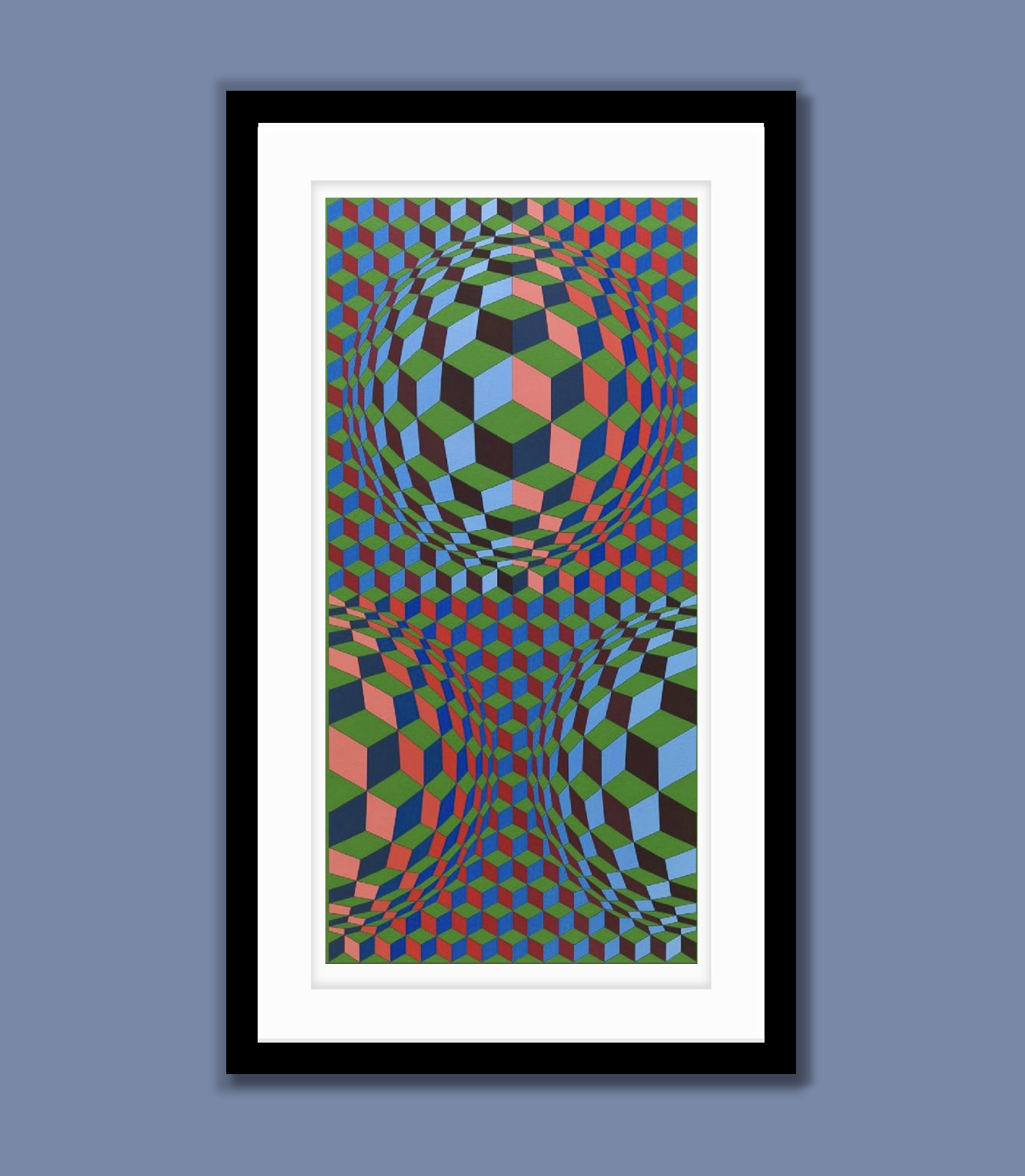


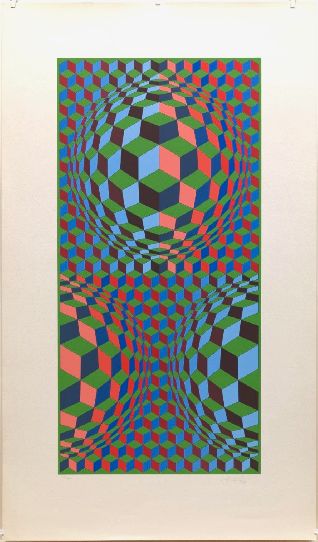

Title: Geometric Abstraction Nadir Screenprint Op art By Victor Vasarely
Shipping: $200.00
Artist: N/A
Period: 20th Century
History: N/A
Origin: Central Europe > France
Condition: Museum Quality
Item Date: N/A
Item ID: 6765
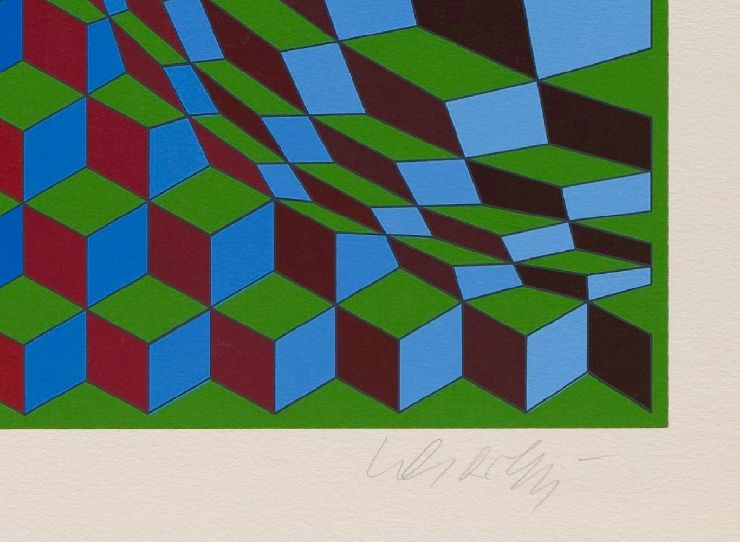
A spectacular example of geometric abstraction by Victor Vasarely (French, 1908–1997). Nadir is a color screenprint measuring 34 x 16½ inches (image) on 44 x 25½ inches (paper). The work is signed in pencil in the lower right and numbered 73/250 in pencil in the lower left. Originally unframed, it has since been presented in a beautiful, hand-cut, double-matted contemporary black frame. Condition: Very good, with minor scattered foxing in the lower left margin and slight handling creases to the margins. Victor Vasarely was a Hungarian-born, French artist widely regarded as the “grandfather” and leading figure of the Op Art movement. His pioneering investigations into optical perception, movement, and geometric form laid the foundation for Op Art as an international visual language. Vasarely’s early work, including his iconic Zebra series from the 1930s, is considered by many to be among the earliest expressions of Op Art, predating the movement’s formal recognition by several decades.
Victor Vasarely (1908–1997) was a Hungarian-born, French artist whose personal journey closely mirrored the development of modern abstraction and ultimately led to the birth of Op Art. Born in Pécs, Hungary, Vasarely initially studied medicine before turning to art, enrolling at the Mühely Academy in Budapest—often described as the Hungarian Bauhaus—where he absorbed principles of geometry, visual perception, and modern design. In 1930, he moved to Paris, working as a graphic designer while refining a visual language rooted in optical illusion, movement, and scientific precision. His early experiments, including the seminal Zebra series of the 1930s, explored how form and contrast could create the sensation of motion on a flat surface, laying the groundwork for Op Art decades before the term existed. By the 1950s and 1960s, Vasarely achieved international recognition, becoming a central figure in the Op Art movement and exhibiting worldwide. He believed art should be universal, reproducible, and accessible, often embracing printmaking as a democratic medium. Throughout his career, Vasarely merged art, mathematics, and visual psychology, leaving a lasting legacy as both a visionary artist and a theorist who reshaped how viewers physically experience art through their own perception.
Link: https://en.wikipedia.org/wiki/Victor_Vasarely
1947-1951: Developing geometric abstract art (optical art): Finally, Vasarely found his own style. The overlapping developments are named after their geographical heritage. Denfert refers to the works influenced by the white tiled walls of the Paris Denfert - Rochereau metro station. Ellipsoid pebbles and shells found during a vacation in 1947 at the Breton coast at Belle Île inspired him to the Belles-Isles works. Since 1948, Vasarely usually spent his summer months in Gordes in Provence-Alpes-Côte d'Azur. There, the cubic houses led him to the composition of the group of works labelled Gordes/Cristal. He worked on the problem of empty and filled spaces on a flat surface as well as the stereoscopic view.
Tribute to Malevitch (1954), Ciudad Universitaria de Caracas
1951-1955: Kinetic images, black-white photographies: From his Gordes works he developed his kinematic images, superimposed acrylic glass panes create dynamic, moving impressions depending on the viewpoint. In the black-white period he combined the frames into a single pane by transposing photographies in two colours. Tribute to Malevitch, a ceramic wall picture of 100 m² adorns the University of Caracas, Venezuela which he co-designed in 1954 with the architect Carlos Raúl Villanueva, is a major work of this period. Kinetic art flourished and works by Vasarely, Calder, Duchamp, Man Ray, Soto, Tinguely were exhibited at the Denise René gallery under the title Le Mouvement (the motion). Vasarely published his Yellow Manifest. Building on the research of constructivist and Bauhaus pioneers, he postulated that visual kinetics (plastique cinétique) relied on the perception of the viewer who is considered the sole creator, playing with optical illusions.
Supernovae (1959-61) in Tate Modern
1955-1965: Folklore planétaire, permutations and serial art: On 2 March 1959, Vasarely patented his method of unités plastiques. Permutations of geometric forms are cut out of a coloured square and rearranged. He worked with a strictly defined palette of colours and forms (three reds, three greens, three blues, two violets, two yellows, black, white, gray; three circles, two squares, two rhomboids, two long rectangles, one triangle, two dissected circles, six ellipses) which he later enlarged and numbered. Out of this plastic alphabet, he started serial art, an endless permutation of forms and colours worked out by his assistants. (The creative process is produced by standardized tools and impersonal actors which questions the uniqueness of a work of art.) In 1963, Vasarely presented his palette to the public under the name of Folklore planetaire.
1965-: Hommage à l'hexagone, Vega: The Tribute to the hexagon series consists of endless transformations of indentations and relief adding color variations, creating a perpetual mobile of optical illusion. In 1965 Vasarely was included in the Museum of Modern Art exhibition The Responsive Eye, created under the direction of William C. Seitz. His Vega series plays with spherical swelling grids creating an optical illusion of volume. In October 1967, designer Will Burtin invited Vasarely to make a presentation to Burtin's Vision ’67 conference, held at New York University.
On 5 June 1970, Vasarely opened his first dedicated museum with over 500 works in a renaissance palace in Gordes (closed in 1996). A second major undertaking was the Foundation Vasarely in Aix-en-Provence, a museum housed in a distinct structure specially designed by Vasarely. It was inaugurated in 1976 by French president Georges Pompidou, two years after his death. Sadly the museum is now in a state of disrepair, several of the pieces on display have been damaged by water leaking from the ceiling. Also, in 1976 his large kinematic object Georges Pompidou was installed in the Centre Pompidou in Paris and the Vasarely Museum located at his birthplace in Pécs, Hungary, was established with a large donation of works by Vasarely. In the same decade, he took a stab at industrial design with a 500-piece run of the upscale Suomi tableware by Timo Sarpaneva that Vasarely decorated for the German Rosenthal porcelain maker's Studio Linie.[3] In 1982 154 specially created serigraphs were taken into space by the cosmonaut Jean-Loup Chrétien on board the French-Soviet spacecraft Salyut 7 and later sold for the benefit of UNESCO. In 1987, the second Hungarian Vasarely museum was established in Zichy Palace in Budapest with more than 400 works.
He died age 90 in Paris on 15 March 1997.
A new Vasarely exhibit was mounted in Paris at Musee en Herbe in 2012.