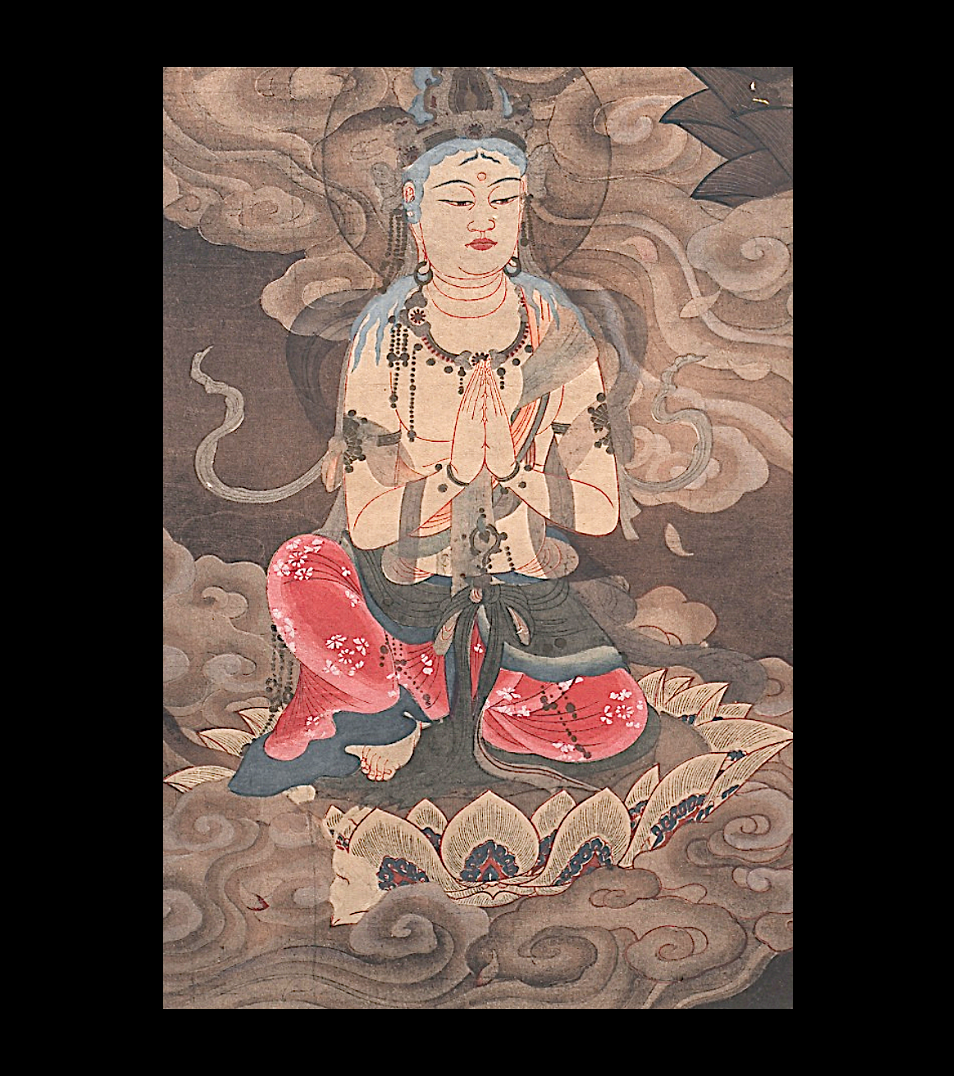
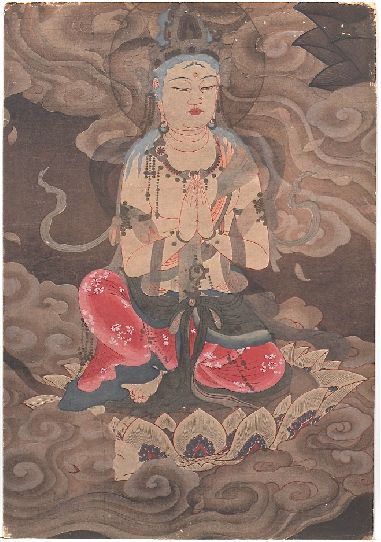
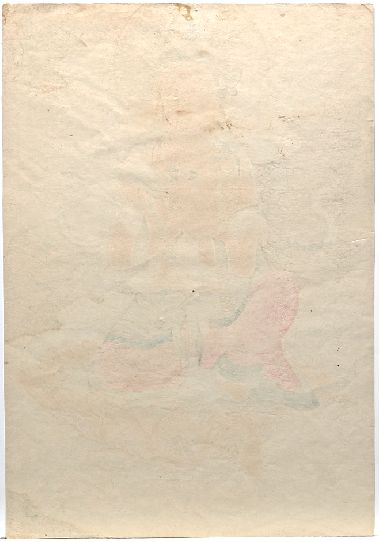
Title: Japanese Edo Gouache Paper Painting of Kannon Seated On Lotus
Shipping: $39.00
Artist: N/A
Period: 18th Century
History: N/A
Origin: N/A
Condition: Very Good
Item Date: 1603 to 1868
Item ID: 6436
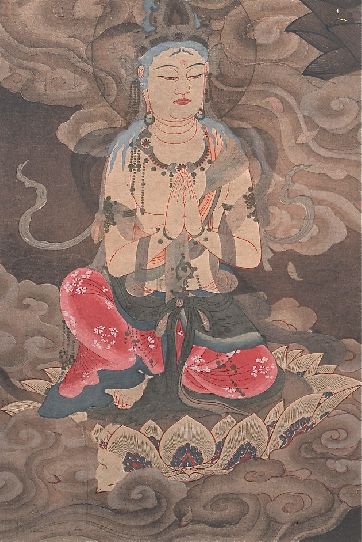
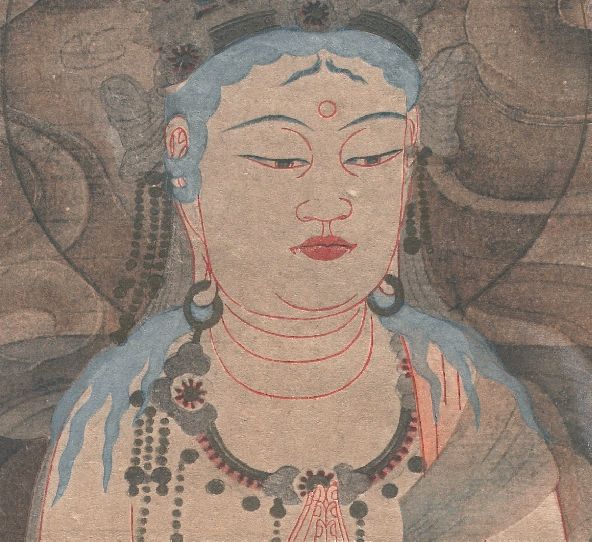
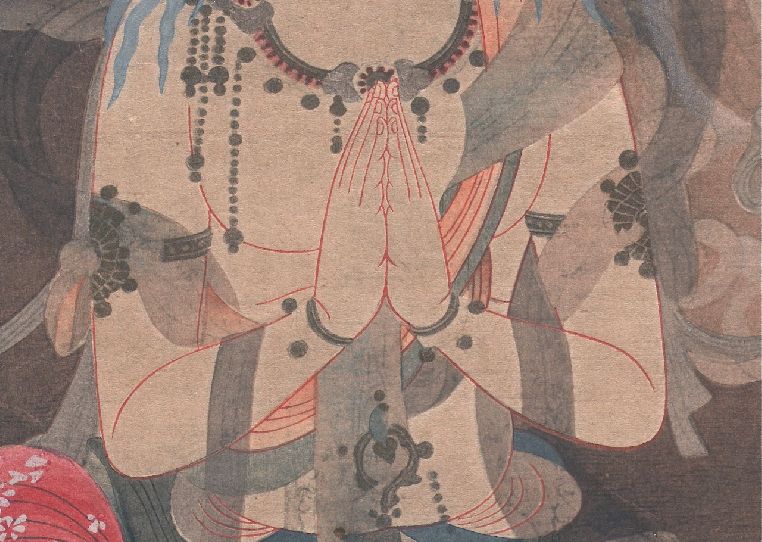
A Stunning Japanese Hand-Painted Gouache of Kannon Seated on a Lotus This antique Japanese gouache painting on paper depicts Kannon seated serenely upon a lotus throne amid drifting clouds. The composition is softly colored, with delicate tonal shading and subtle accents of red. Unframed and likely dating to the Edo period, the work reflects both devotional intent and refined craftsmanship. Condition: Handling and edge wear consistent with age. Size: 14¼ × 9¾ inches. Guanyin (pinyin; earlier transliterations include Quan Yin, Kwan Yin, or Kuanyin) is the East Asian goddess of mercy and a bodhisattva embodying compassion, venerated by followers of Mahayana Buddhism. The name Guanyin is an abbreviated form of Guanshiyin, meaning “Observing the Sounds (or Cries) of the World.” She is also known as Guanyin Pusa (literally, “Bodhisattva Guanyin”). In Buddhist belief, Guanyin is said to receive departed souls by placing them within the heart of a lotus and guiding them to the Western Pure Land of Sukhāvatī. In Japanese Vajrayāna, or Shingon Buddhism, Amitābha is revered as one of the thirteen Buddhist deities to whom practitioners may pay homage. During the Tokugawa (Edo) period, both Buddhism and Shinto remained central to Japanese spiritual life. Buddhism, reinforced by Neo-Confucian principles, helped define standards of social behavior and was particularly supported by the upper classes. Although its political influence had waned, Buddhism benefited from government policies—most notably in 1640, when the bakufu required all citizens to register with a Buddhist temple as part of efforts to suppress Christianity. Japan was understood as the land of the kami, possessing a unique spiritual destiny. At the same time, scholarly pursuits such as mathematics, astronomy, cartography, engineering, and medicine were encouraged. Great emphasis was placed on craftsmanship and artistic excellence. This cultural flowering produced masterworks across the arts, including woodblock prints known as ukiyo-e. The pursuit of beauty and pleasure in everyday life came to be known as ukiyo, or “the floating world,” celebrating fashion, popular entertainment, and refined aesthetic sensibilities. The bold compositions, flattened planes, and strong linear outlines of this art later had a profound influence on Western artists such as Edgar Degas and Vincent van Gogh. * Our Mission Our purpose is to discover and present exceptional art by collecting a vast range of contemporary, vintage, antique, and collectible works from around the globe. Individually handcrafted and carefully selected, each piece is given new life by restoring its unique story. Every artwork is edited and chosen by us for its quality, craftsmanship, and artistic merit before being offered. These collectibles are selected with both the artist and the collector in mind. We are committed to enriching our customers’ lives by discovering, creating, and presenting only the finest art the world has to offer today. We are taste-makers, art advisers, consultants, and publishers of compelling art stories—serving as trusted intermediaries between buyers and sellers. Dedicated to high-end art patrons, we aim to catalog the world’s most exceptional works and share them with a wider audience.
Guanyin, also known as Quan Yin, Kwan Yin, or Kuanyin, is a bodhisattva associated with compassion and mercy in Mahayana Buddhism, and is venerated as a goddess in East Asian cultures. The history of Guanyin can be traced back to ancient India, where the concept of bodhisattvas originated within the Mahayana Buddhist tradition. According to Buddhist tradition, Guanyin was originally a male bodhisattva named Avalokiteshvara, who was highly revered for his compassion and vowed to alleviate the suffering of all sentient beings. However, over time, Avalokiteshvara's image and attributes evolved as Buddhism spread to different regions of Asia, including China, Japan, Korea, and Vietnam. In China, Guanyin is often depicted as a female figure with a serene and compassionate expression, and is known as the "Goddess of Mercy." She is believed to hear the cries and pleas of those in need, and is known to assist those who call upon her for help. Guanyin is often portrayed holding a vase of pure water or a willow branch, which symbolizes healing and compassion. She is also sometimes depicted with multiple arms and eyes, signifying her ability to reach out and see the suffering of all beings. Guanyin's popularity spread to other East Asian countries, where she is also revered as a compassionate and merciful figure. In Japan, she is known as Kannon and is regarded as a bodhisattva associated with compassion and healing. In Korea, she is known as Gwan-eum or Gwanse-eum, and in Vietnam, she is known as Quan Âm. In each culture, Guanyin is often depicted differently, but the underlying theme of compassion and mercy remains consistent. The history of Guanyin is deeply intertwined with the development and spread of Mahayana Buddhism in East Asia, and her veneration continues to be an important aspect of Buddhist practice and devotion in the region. She is often invoked by devotees for protection, guidance, and blessings, and is regarded as a source of compassion and solace for those who are suffering.
Link: http://en.wikipedia.org/wiki/Buddhism
In the Mahayana, the Buddha tends not to be viewed as merely human, but as the earthly projection of a beginningless and endless, omnipresent being beyond the range and reach of thought. Moreover, in certain Mahayana sutras, the Buddha, Dharma and Sangha are viewed essentially as One: all three are seen as the eternal Buddha himself.
The Buddha's death is seen as an illusion, he is living on in other planes of existence, and monks are therefore permitted to offer "new truths" based on his input. Mahayana also differs from Theravada in its concept of śūnyatā (that ultimately nothing has existence), and in its belief in bodhisattvas (enlightened people who vow to continue being reborn until all beings can be enlightened).
Celestial Buddhas are individuals who no longer exist on the material plane of existence, but who still aid in the enlightenment of all beings.