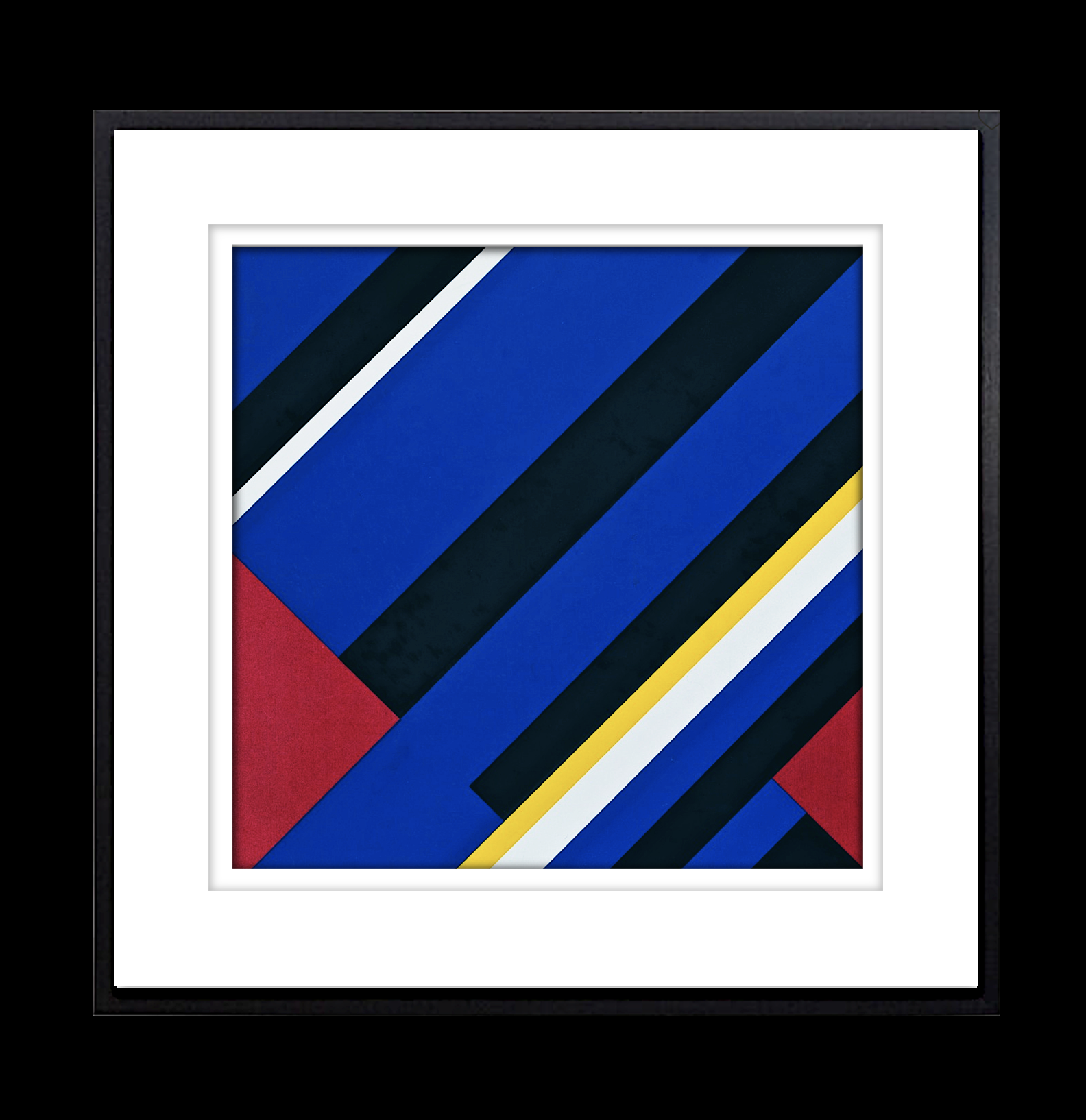


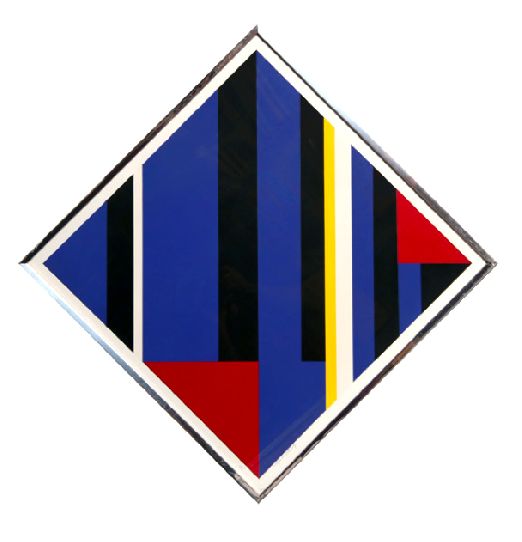
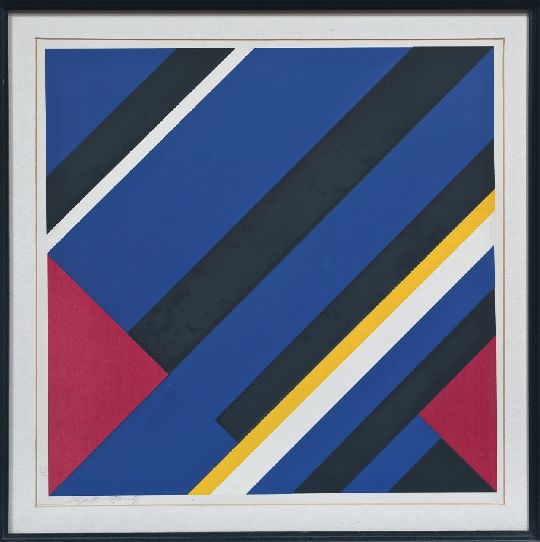
Title: Neoplasticism Diamond Silkscreen print on paper Artist Ilya Bolotowsky
Shipping: $29.00
Artist: N/A
Period: 20th Century
History: Art
Origin: Central Europe > Russia
Condition: Good
Item Date: 1970
Item ID: 6226
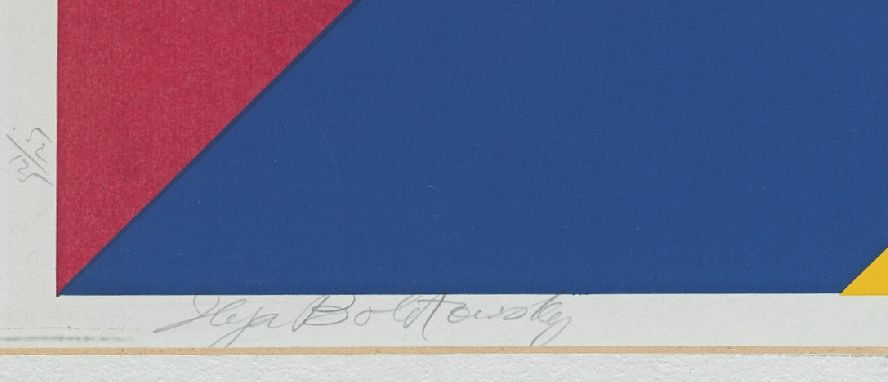
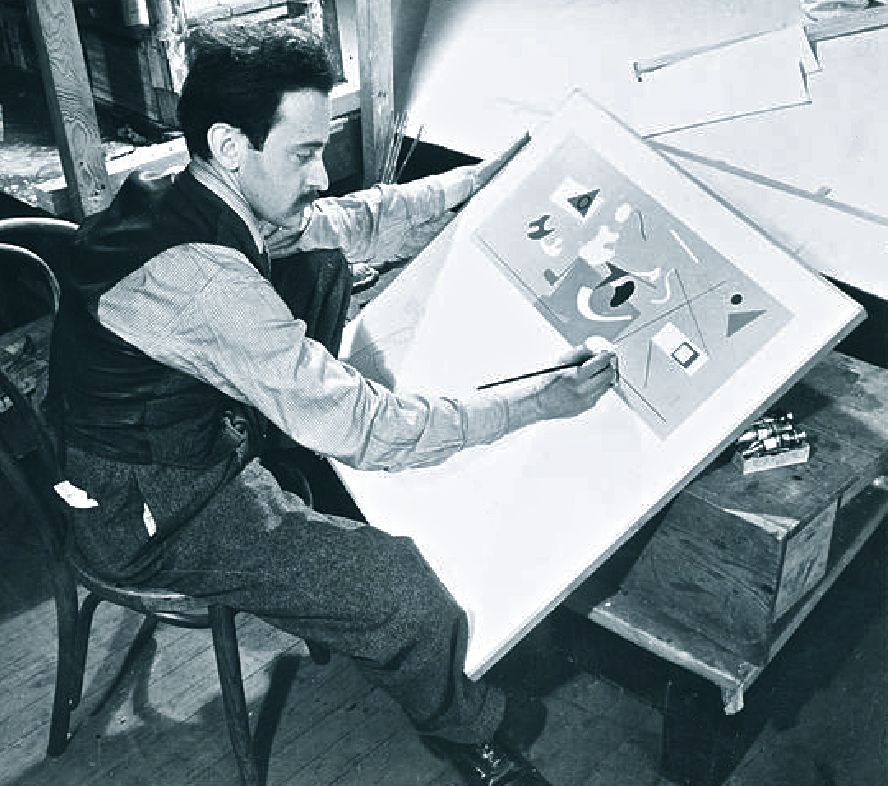
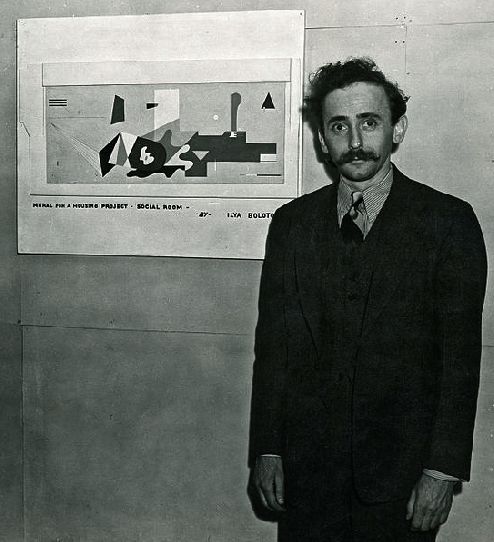
This is a true silkscreen abstract masterpiece by one of the great Neoplasticist artists, Ilya Bolotowsky (Russian/American, 1907–1981). Diamond, circa 1970, is a screenprint in colors on Hi-White paper, signed in pencil and numbered 52/125. The work is matted and framed, with an overall size of 27 x 27 inches. A very rare silkscreen, it is signed and marked by the artist. Ilya Bolotowsky was born in Petrograd, Russia, in 1907 and emigrated to the United States in 1923, becoming an American citizen in 1929. He studied at the National Academy of Design in New York from 1924 to 1930, where he received numerous honors, including drawing and painting prizes, a Louis Comfort Tiffany Foundation Scholarship, and a Yaddo Foundation Fellowship. Bolotowsky was deeply influenced by the work of Piet Mondrian, which he encountered in the Gallatin Collection, as well as by Joan Miró at the Pierre Matisse Gallery. These encounters led to his first abstract works in 1933. In the mid-1930s, he became a member of The Ten, alongside artists such as Mark Rothko and Adolph Gottlieb. He was also an active participant in the WPA Federal Art Project and a co-founder and charter member of the American Abstract Artists group. Throughout his career, Bolotowsky taught at Brooklyn College, Hunter College, the University of Wisconsin, the University of New Mexico, and Columbia University. He received the Abstract Painting Prize from the National Institute of Arts and Letters, as well as grants from the Museum of Non-Objective Painting in New York. Bolotowsky is also well known for his public murals, including works created for the Hall of Medical Science at the 1936 World’s Fair, the Chronic Diseases Hospital in New York, two commissions for the Phillips Steel Company in Pittsburgh, Cinema I, and the Passenger Ship Terminal in New York. His work is held in major corporate collections, including Chase Manhattan Bank and Ciba-Geigy, and has been exhibited extensively in galleries and museums worldwide. Bolotowsky’s work is represented in leading museum collections such as the Whitney Museum of American Art, the Museum of Modern Art, the Guggenheim Museum in New York, the Joseph H. Hirshhorn Collection in Washington, D.C., and the National Collection of Fine Arts at the Smithsonian Institution. Condition: Not inspected out of frame. Frame shows wear. Visible surface discolorations. All artworks are carefully edited and selected for their quality and craftsmanship prior to posting. These collectibles are chosen with both the artist and collector in mind. We are committed to enhancing our clients’ lives by discovering, creating, and presenting only the finest art available today. As taste-makers, art advisers, consultants, and publishers of exceptional art stories, our role is to serve as trusted intermediaries between buyers and sellers. We vet works for discerning, high-end art patrons and are dedicated to cataloging and sharing the world’s most exceptional art.
Ilya Bolotowsky (1907–1981) was a pioneering figure in American abstraction and one of the leading proponents of Neoplasticism in the United States. Born in Petrograd, Russia, he emigrated to New York in 1923, where he trained at the National Academy of Design before moving decisively toward abstraction in the early 1930s. Deeply influenced by Piet Mondrian’s work in the Gallatin Collection, Bolotowsky embraced geometric structure, balance, and primary color relationships as a lifelong visual language. During the Depression era, he was an active participant in the WPA Federal Art Project and a co-founder of the American Abstract Artists, helping to legitimize non-objective art in a climate dominated by realism. A member of The Ten alongside artists such as Mark Rothko and Adolph Gottlieb, Bolotowsky played a crucial role in shaping the trajectory of American modernism. His influence extended through decades of teaching, major mural commissions, and inclusion in the collections of institutions such as MoMA, the Guggenheim, and the Whitney, securing his legacy as a foundational architect of American geometric abstraction.
Link: http://en.wikipedia.org/wiki/Ilya_Bolotowsky
Ilya Bolotowsky (July 1, 1907 – November 22, 1981) was a leading early 20th-century painter in abstract styles in New York City. His work, a search for philosophical order through visual expression, embraced cubism and geometric abstraction and was much influenced by Dutch painter Piet Mondrian.
Born to Jewish parents in St. Petersburg, Russia, Bolotowsky immigrated to America in 1923 via Constantinople, settling in New York City. He attended the National Academy of Design. He became associated with a group called "The Ten Whitney Dissenters," or simply "The Ten," artists, including Louis Schanker, Adolph Gottlieb, Mark Rothko and Joseph Solman, who rebelled against the strictures of the Academy and held independent exhibitions.
During this period, Bolotowsky came under the influence of the Dutch painter Piet Mondrian and the tenets of neoplasticism, a movement that advocated the possibility of ideal order in the visual arts. Bolotowsky adopted his mentor's use of horizontal and vertical geometric pattern and a palette restricted to primary colors and neutrals.
In 1936, having turned to geometric abstractions, he was one of the founding members of the American Abstract Artists, a cooperative formed to promote the interests of abstract painters and to increase understanding between themselves and the public.
He taught at Black Mountain College during the period 1946–1948, Kenneth Noland was among his students.
Bolotowsky's mural for the Williamsburg Housing Project in Brooklyn, was one of the first abstract murals done under the Federal Art Project. Despite Bolotowsky's clear, precise control of his images, he emphasized the role of intuition over formula in determining his compositions.
In the 1960s, he began making three-dimensional forms, usually vertical and straight-sided. He taught humanities and fine arts at the Southampton, New York campus of Long Island University and The University of New Mexico.
On September 21, 2012, Sotheby's auctioned a Bolotowsky painting that was found at a North Carolina Goodwill store for $8 and was sold for $34,375.