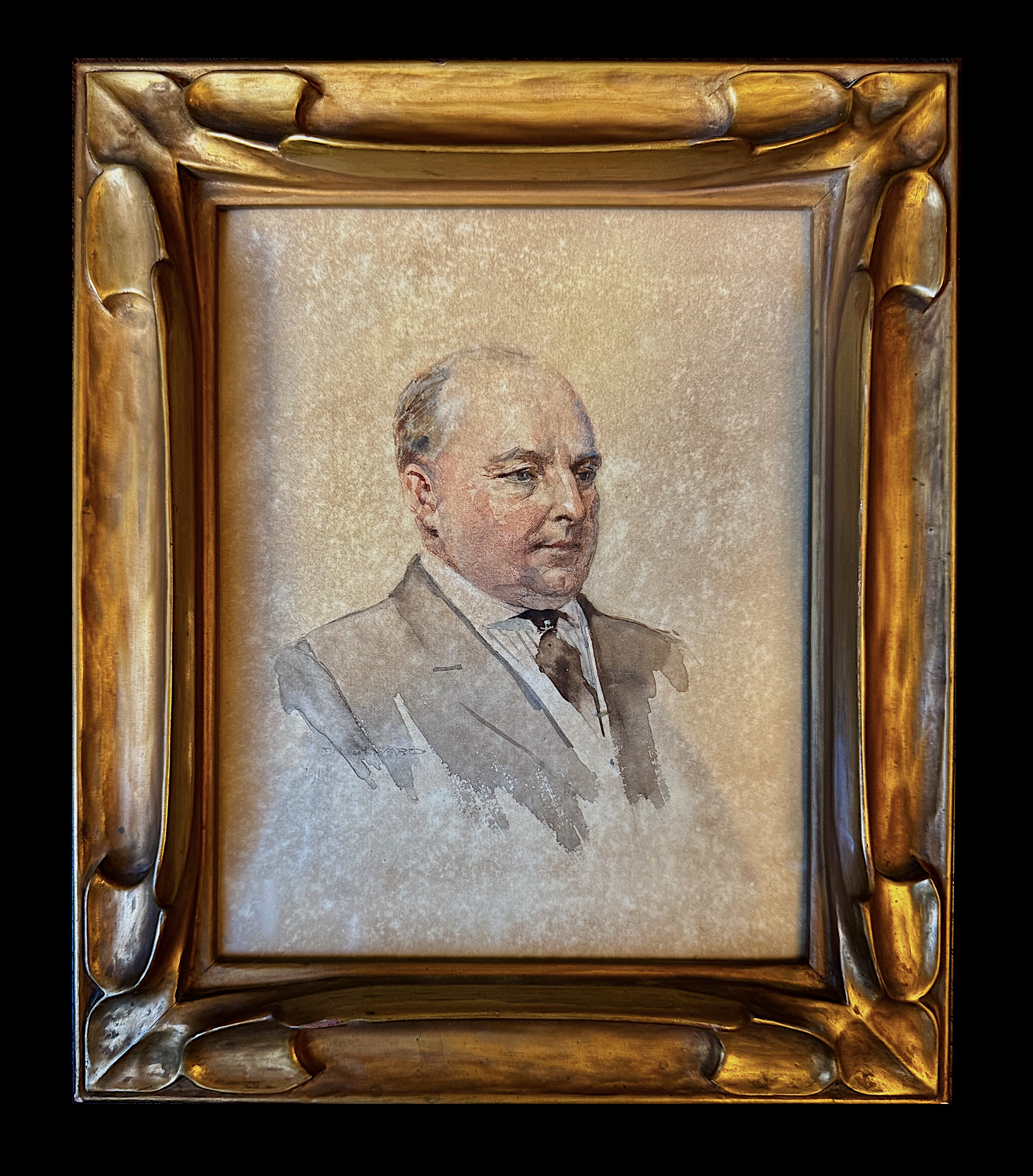


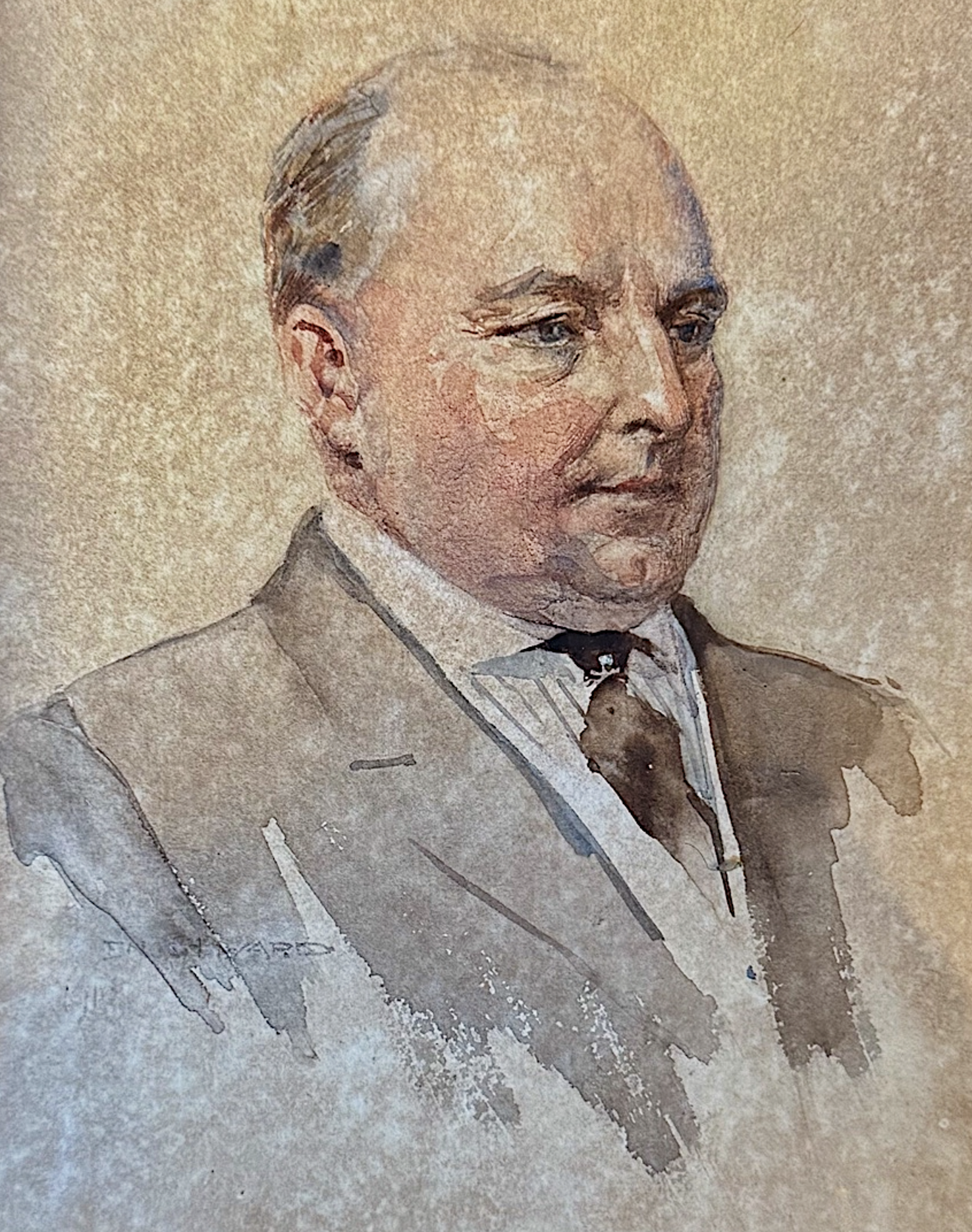
Title: Watercolor Portrait by Artist and Illustrator Edmund Franklin Ward
Shipping: $29.00
Artist: N/A
Period: 20th Century
History: Art
Origin: North America > United States
Condition: N/A
Item Date: N/A
Item ID: 5651
This is a spectacular example of the work of a highly skilled artist. The watercolor depicts a refined business portrait of a man who appears to be an executive, rendered with remarkable sensitivity and confidence. The work is presented on beige textured paper and set within a beautiful, hand-carved, gilded wooden Art Nouveau frame that complements the painting elegantly. Edmund Franklin Ward was one of the most sought-after artists of his time, celebrated for his exceptional ability to capture expression and character in watercolor. His work is sought after by collectors who recognize his technical mastery and is admired by fellow artists for its sophistication and timeless quality. Edmund Franklin Ward is known to have supplemented his income by accepting private portrait commissions, including portraits for businessmen and other private clients, which was a common practice among successful illustrators of his era. While his primary livelihood came from magazine illustration—particularly during the height of the American illustration market—portrait commissions provided steady additional income and creative flexibility between publishing deadlines. These works were typically more formal than his narrative illustrations and focused on likeness, character, and professionalism, appealing to executives and patrons who wanted refined, traditional portraits. Although fewer of these commissioned portraits are widely reproduced today, they are documented through private collections and auction records and reflect Ward’s versatility and solid reputation beyond commercial illustration. Edmund Franklin Ward did accept commissions for portraits. In addition to his well-known magazine illustration work, he painted commissioned portraits for private clients, applying the same strong draftsmanship and narrative sensitivity found in his commercial art. His portrait work—often executed in oil or watercolor—focused on character, expression, and likeness, reflecting his training as an illustrator and his ability to tell a visual story through the human figure. Edmund Franklin Ward (1892–1990) was a prominent American illustrator and watercolorist whose career spanned the golden age of magazine illustration. Trained at the Art Students League of New York—where he studied alongside and shared a studio with Norman Rockwell—Ward developed a strong foundation in draftsmanship and visual storytelling. He began illustrating professionally before the age of twenty and became widely known for his long association with The Saturday Evening Post, as well as contributions to Collier’s, Red Book, and Ladies’ Home Journal. While his early work favored richly detailed oil paintings, Ward later embraced watercolor and wash, adopting a lighter, more expressive style that emphasized character, humor, and narrative movement. In addition to illustration, he painted murals and landscapes, notably spending summers on Monhegan Island. His work captures the warmth, optimism, and everyday drama of American life, securing his legacy as a respected figure in 20th-century American illustration. This watercolor is a superb example of Edmund Franklin Ward’s refined portrait work, depicting a confident executive with exceptional sensitivity, draftsmanship, and control of the medium. Rendered on beige textured paper and housed in an elegant, hand-carved, gilded Art Nouveau frame, the presentation enhances the sophistication of the image. Ward (1892–1990), a prominent American illustrator and watercolorist trained at the Art Students League alongside Norman Rockwell, was among the most sought-after artists of the golden age of magazine illustration, best known for his work for The Saturday Evening Post and other major publications. In addition to his commercial illustration, he regularly accepted private portrait commissions—particularly for businessmen—using watercolor and oil to focus on likeness, character, and professional presence. These portraits, less frequently reproduced today but documented in private collections and auction records, reflect Ward’s versatility, technical mastery, and enduring reputation among collectors and fellow artists alike.
Edmund Franklin Ward is most often compared to Norman Rockwell and N.C. Wyeth, as all three were masters of narrative realism during the golden age of American illustration, yet each approached storytelling differently. Like Rockwell, Ward focused on everyday American life and character-driven scenes, but his work is generally looser, more painterly, and less sentimental, relying on gesture and expression rather than tightly staged moments. Compared to Wyeth, whose illustrations are dramatic and heroic, Ward’s scenes feel more intimate and observational, emphasizing humor and human interaction over epic narrative. Ward’s frequent use of watercolor and wash gives his work a lighter, more spontaneous quality, positioning him between Rockwell’s polished realism and Wyeth’s bold drama, and making his style distinctly his own while clearly rooted in the same illustrative tradition. There were several artists very similar to Edmund Franklin Ward, both stylistically and professionally, especially within the Golden Age of American Illustration. Ward worked in a shared visual language with artists who focused on narrative realism, character-driven scenes, and expressive watercolor and oil techniques. The closest and most often cited comparison is Norman Rockwell. They studied together at the Art Students League, shared a studio early on, and both illustrated for The Saturday Evening Post. While Rockwell became more iconic and sentimental, Ward’s work often feels a bit looser and more painterly, especially in watercolor. Other artists closely aligned with Ward include Mead Schaeffer, N.C. Wyeth, and J.C. Leyendecker—all master storytellers who emphasized strong draftsmanship, dramatic composition, and believable human character. Ward’s lighter wash technique and humor also place him near illustrators like Wallace Morgan and John Clymer, who blended fine art sensibilities with commercial illustration. Importantly, there was no other major illustrator named “Ward” working at the same level in this period whose style closely mirrored Edmund Franklin Ward’s work. When people refer to a “Ward-like” artist, they are usually describing this broader group of early–mid 20th century American illustrators who captured everyday life with warmth, clarity, and narrative strength—rather than another artist sharing his name. He was born in White Plains, New York, where he spent most of his career and where he also painted a mural for the Federal Building. He studied at the Art Students League with Norman Rockwell with whom he shared a studio. Among his teachers at the League were Thomas Fogarty, Edward Dufner, and George Bridgman. He was a member of the Salmagundi Club, the Guild of Freelance