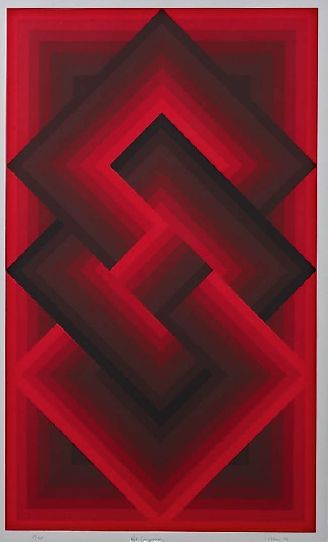

Title: Red Composition Print By Modern Geometric optical Artist Jurgen Peters
Shipping: $100.00
Artist: N/A
Period: Contemporary
History: Art
Origin: Central Europe > Germany
Condition: Excellent
Item Date: 1976
Item ID: 4486
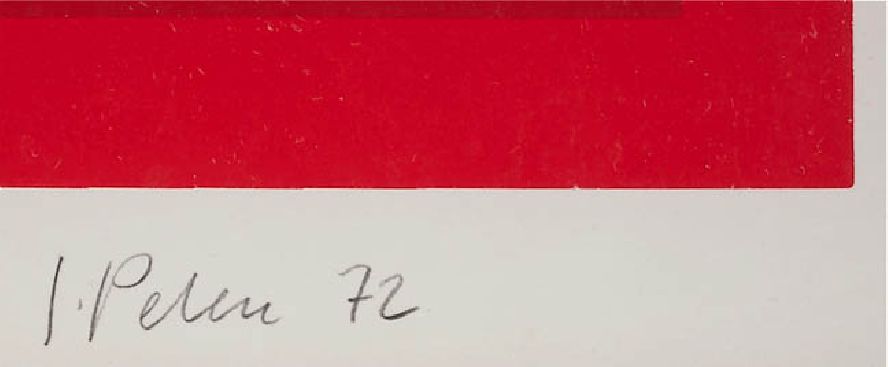
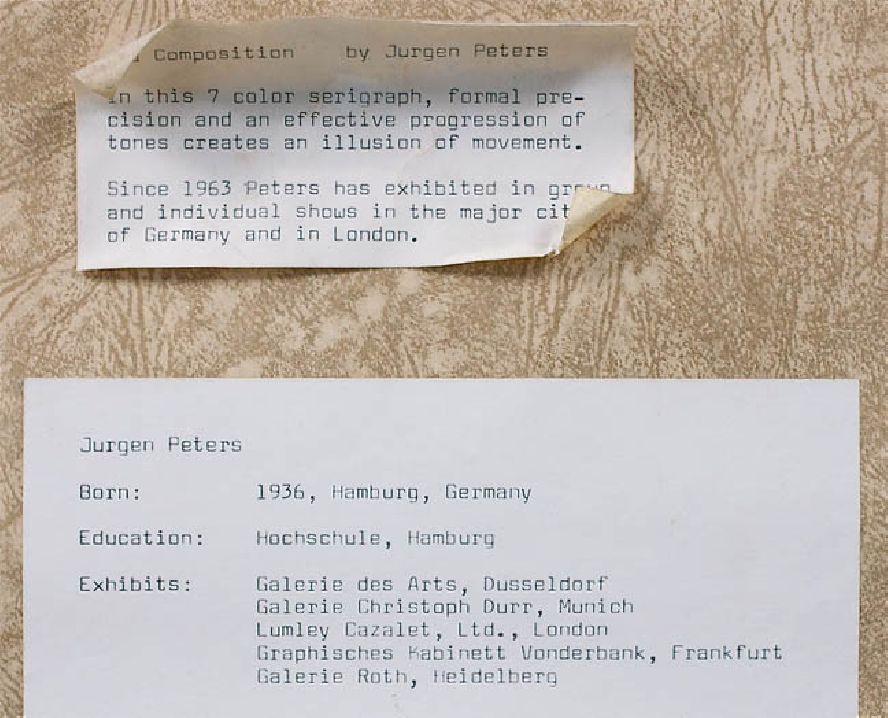
Modern Geometric Artist: Jürgen Peters (German, b. 1936) Title: Red Composition Seven-color serigraph, signed and dated ’76 in pencil in the lower right margin, titled in the lower center margin, and numbered 29/100 in pencil in the lower left margin. Image size approximately 29 3/8" x 17 1/2". Newly matted and framed under UV-protective Plexiglas, presented in a double white mat with a black wood frame. Overall dimensions approximately 34 1/2" x 22 1/2". Typed biographical information about the artist is affixed to the verso. Condition: Very good. Signed in pencil by the artist. Designed and executed by Jürgen Peters, a German Post-War and Contemporary artist, this red silk-screen composition of geometric forms demonstrates Peters’ expert command of geometry, repetition, and color gradation. His imagery is defined by structured patterns and optical precision, allowing him to create visually dynamic compositions that engage the viewer through movement and depth. Peters became widely recognized in the 1970s as an Op Art artist, and his work was regularly featured and advertised in the pages of Art in America. Jürgen Peters was born in 1936 in Hamburg, Germany. During the 1970s, he emerged as a prominent optical artist and was a contemporary of Victor Vasarely, Yaacov Agam, and Bridget Riley, situating his work firmly within the international Op Art movement. Peters’ unframed works have appeared at auction on multiple occasions, with realized prices historically ranging from approximately $300 to $3,000, depending on size and medium. Today, his work commands several thousand dollars in retail gallery settings and is considered highly collectible.
Jürgen Peters, born in 1936 in Hamburg, Germany, emerged as a significant figure in Post-War geometric and Op Art during the 1960s and 1970s, a period marked by intense experimentation with perception, structure, and visual movement. Influenced by the Bauhaus legacy and the rise of European abstraction, Peters focused on precise geometric systems, color modulation, and serial repetition to create works that activate the viewer’s eye through optical vibration and spatial illusion. His career gained international visibility in the 1970s, when his prints and paintings were widely exhibited and regularly featured in leading art publications such as Art in America. Working alongside and in dialogue with contemporaries like Victor Vasarely, Yaacov Agam, and Bridget Riley, Peters contributed to the broader Op Art movement by emphasizing clarity of form and disciplined craftsmanship. Today, his work is recognized for its rigorous visual intelligence and remains an important example of German geometric abstraction from the post-war era.